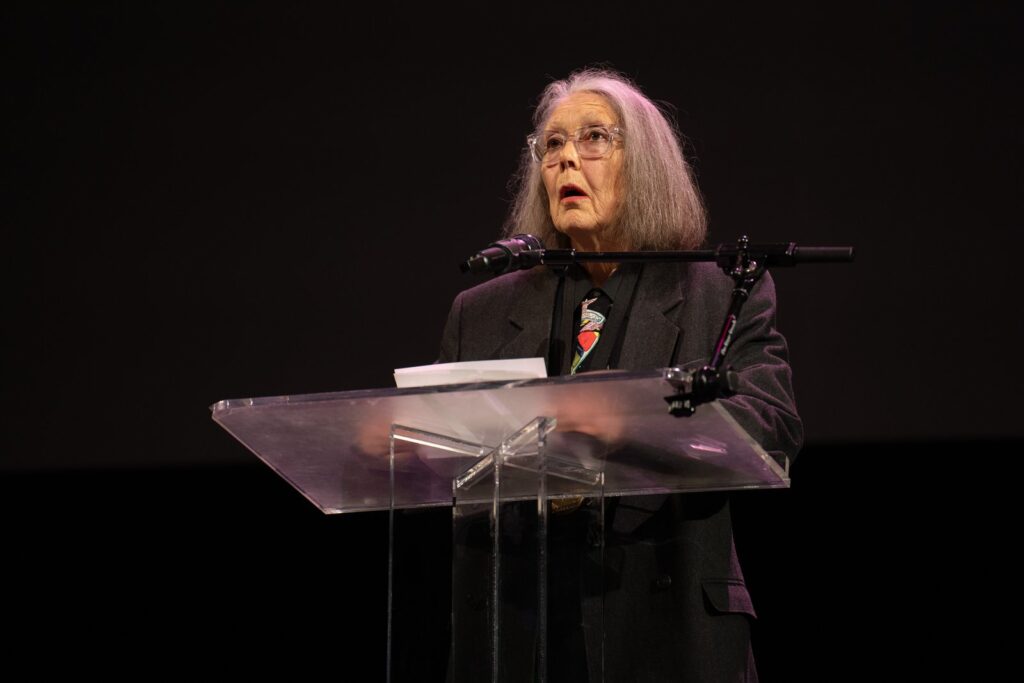
Canadian poet Anne Carson won the 2026 Nobel Prize in Literature on Thursday. The Swedish Academy honored her “for her bold and inventive oeuvre that, in playful dialogue with the classical tradition, has created new forms for contemporary literature.”
Carson, 76, is one of the most original writers alive, a classics scholar who turns ancient Greek poetry into something that feels startlingly modern. If you haven’t read her, here’s where to start.
Who is Anne Carson?
Carson was born in Toronto in 1950 and spent her career teaching classics at universities across North America while writing poetry, essays and translations. She’s best known for translating ancient Greek writers like Sappho and Euripides, and for books that refuse to fit in one category: part poem, part essay, part play.

She’s married to the artist Robert Currie, and in 2024 she revealed in an essay for the London Review of Books that she has Parkinson’s disease. “A symptom particularly mortifying to me was that my handwriting disintegrated,” she wrote, The Irish Times noted.
What are Anne Carson’s best books?
- Autobiography of Red (1998): a novel in verse that retells a Greek myth as a coming-of-age love story. The usual starting point.
- Nox (2010): a book about her older brother’s death, built like a scrapbook around a Latin elegy.
- If Not, Winter (2002): her translation of the surviving fragments of Sappho.
- Float (2016): 22 pamphlets in a clear case, readable in any order.
- Norma Jeane Baker of Troy (2019): a performance piece that blends Helen of Troy with Marilyn Monroe.
Her definition of her own art gets quoted a lot: “If prose is a house, poetry is a man on fire running quite fast through it.”
How much is the Nobel Prize in Literature worth?
The prize comes with 12 million Swedish crowns, about $1.2 million, Reuters reported. Carson is one of fewer than 20 women to win it in its 125-year history. Last year’s winner was Hungarian novelist László Krasznahorkai.
The BeezLoop Take
The Nobel is often accused of picking writers nobody’s heard of. Carson is a fair answer to that. She’s not a bestseller, but she’s spent decades showing that 2,500-year-old poems can still feel urgent, and a lot of younger writers learned how to break the rules by reading her.
There’s also something worth noticing in the timing. A scholar of ancient Greek, writing openly about Parkinson’s, honored in a year when so much culture is built for a 15-second scroll. Her work asks for slow attention, and rewards it.
The open question: will the prize send new readers to her, or just to the headline?
Also on BeezLoop: A Stanford psychiatrist shared this year’s Nobel Prize in Medicine.
Sources: The Irish Times · Reuters via Rappler · Nobel Prize