
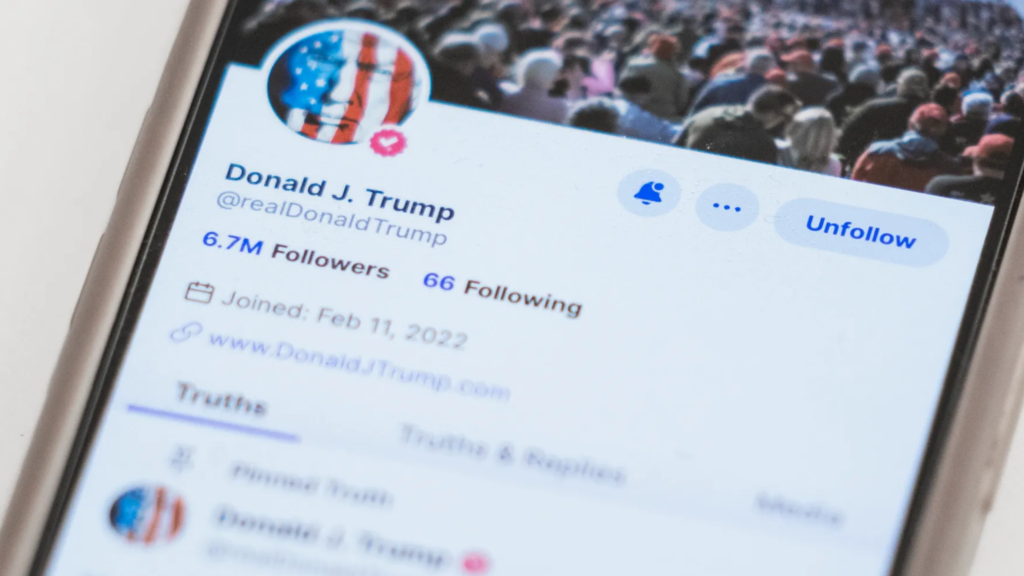
A Truth Social post from the president shows thousands of likes and reposts and a handful of replies. People keep asking the obvious question. The honest answer is that the platform has made it almost impossible to check, and that is the part worth paying attention to.

What you can no longer see
This is the central fact and it is not disputed.
Truth Social restricted site functionality so that a user can only see a few dozen followers on an account, even when a post displays thousands of likes. There is no way from the outside to look at who is doing the engaging.

Trump Media and Technology Group, the parent company, has offered no estimate of what share of accounts on the platform are inauthentic. Most large platforms publish some figure. TMTG does not.
What researchers have actually found
Here is where being precise matters, because everything below is older than people think, about a different platform, or both. We are dating each one deliberately.
- Graphika, December 2022. Researchers found Russian operators using false personas on Truth Social to push voter fraud narratives during the 2022 midterms, tied to a fake right-wing outlet called the Newsroom for American and European Based Citizens, linked to Russia’s Internet Research Agency. It was the first time Russian interference was tied to Truth Social. Graphika counted 19 such accounts on Gab and 10 on Gettr, but never published a count for Truth Social. It also noted the operators persisted there because of an apparent lack of enforcement.
- Cyabra, 2024. Analyzing roughly 7,500 posts about Trump’s hush-money trial, the firm found 17% came from fake accounts, reaching an estimated 49.1 million people. That study was about X, not Truth Social, and it was about one news event two years ago.
- Twitter Audit, May 2017. The widely recycled claim that 49% of Trump’s followers are fake traces to this: a third-party estimator run against his 30.9 million Twitter followers. It is nine years old, about a different platform, and produced by a tool whose own accuracy was never established.
Put plainly: there is documented evidence that foreign operators used Truth Social, from four years ago. There is no current, Truth-Social-specific, quantified public estimate of inauthentic engagement at all. Every number people cite comes from a different platform, a different year, or both.
Why the pattern people notice is not proof
The thing readers describe, high likes and reposts with few substantive comments, is real. It is also what a fan account does.
Liking and resharing take a tap. Writing a comment takes effort and exposes you to argument. Every platform shows a steep drop between passive and active engagement, and on a service whose users largely agree with the person posting, there is less to argue about in the first place.
A bot farm produces that pattern. So does a devoted audience. From outside, with the follower list hidden, they look identical.
The BeezLoop Take
We are not going to tell you Trump’s followers are bots, because nobody outside TMTG can currently know that and anyone stating it as fact is guessing. That includes people we agree with on most things.
What is worth being angry about is the opacity, and it is a bipartisan concern rather than a partisan one. A publicly traded company built entirely on engagement removed the ability to verify engagement. That is not a content moderation decision or a privacy feature. It is a company deciding its own most important metric should not be auditable, at a moment when its valuation depends on that metric.
The Graphika finding is the one that should travel further than it has, with its date attached. In 2022, Russian influence operators ran a fake right-wing news outlet on the platform, and Graphika said they persisted there because nobody was enforcing anything. That is not speculation about likes. It is documented foreign manipulation of an American political audience on a service whose owner is now the sitting president. It is also four years old, and nobody has published a follow-up, which is its own kind of answer.
The stale statistics are a problem on the other side of this, and we had to correct our own draft of this article to avoid repeating it. A 2017 Twitter Audit number and a 2024 study about hush-money-trial posts on X both get recirculated in 2026 as though they say something about Truth Social today. They do not. Every time someone cites them that way, the legitimate research gets easier to dismiss, and the people dismissing it end up being right about that particular citation.
There is also a connection to the story we wrote this morning about federally funded ads. A movement genuinely confident in its reach does not need the Treasury buying NFL airtime. If the online numbers reflected real people in the volume they suggest, the ads would be redundant.
The question
Should a publicly traded company be allowed to hide the engagement metrics its valuation rests on? And if the follower list is invisible, what would it even take to answer this question honestly?
Related: TikTok accused of burying posts nobody outside the company can audit, and most people now post far less than they used to.
Sources: Rolling Stone · The Record, on Graphika research · News8000 on follower counts