

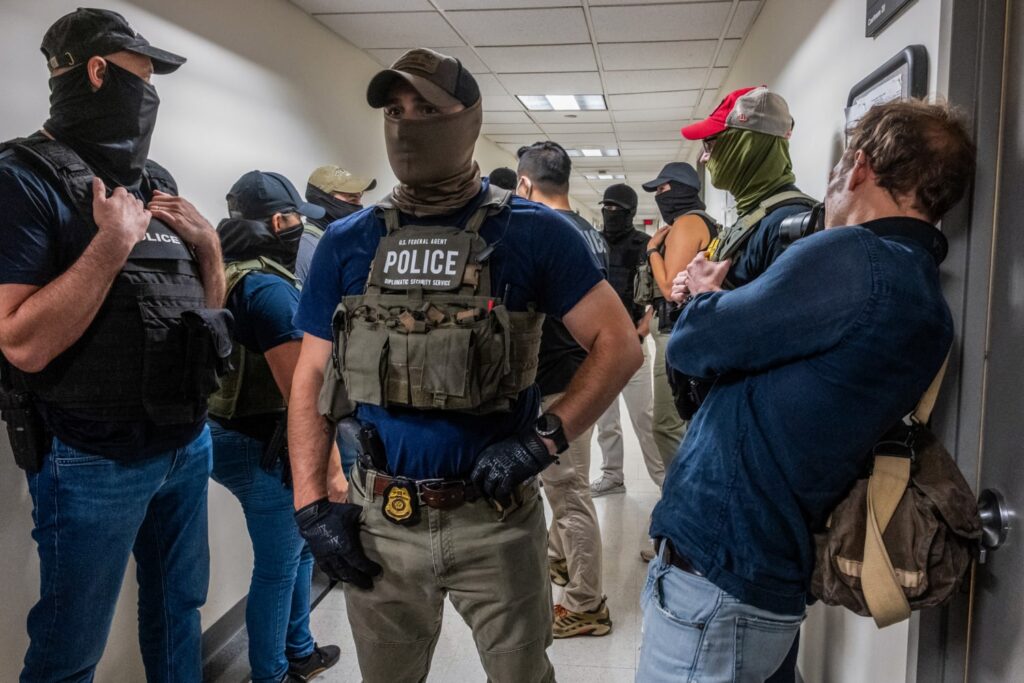
A federal judge has barred immigration officers from making warrantless civil arrests across seven Southern California counties unless they first determine the person is likely to flee. The preliminary injunction was granted September 2 and unsealed Wednesday.

What the order requires
U.S. District Judge Maame Ewusi-Mensah Frimpong ruled that before making a civil immigration arrest without a warrant, an officer must weigh the “totality of the circumstances known to the agent or officer” regarding whether the person is likely to escape. It applies in the Central District of California, covering Los Angeles, Orange, Riverside, San Bernardino, Ventura, Santa Barbara and San Luis Obispo counties. The suit was brought last fall by the ACLU of Southern California, Public Counsel, and Los Angeles immigrant advocacy groups.
This is not a new legal standard, which is the point
Worth being precise, because the ruling is easy to describe as a judge inventing a restriction. Federal law already permits warrantless civil immigration arrests only where the officer has reason to believe the person is likely to escape before a warrant can be obtained. The flight-risk finding is a statutory precondition, not something the court added.

What the plaintiffs alleged is that the precondition was going unmet as a matter of routine: in many arrests they tracked, no documentation was ever produced showing officers had assessed likelihood of escape at all. So the order functions less as a new rule than as an instruction to actually satisfy an existing one, and to create a record showing it. That distinction matters for how the appeal is likely to be argued.
It is the fifth ruling of its kind
Federal judges in Portland, Colorado, Washington, D.C., and the Eastern District of California have already blocked similar warrantless arrest practices. A single district court order is a local constraint; five across different circuits is a pattern, and it is the kind of accumulation that tends to push an issue toward appellate resolution. Whether these rulings survive review is the open question, and none of them has been tested at that level yet.
What it means on the ground
For residents of those seven counties, the practical change is narrow but real: an officer making a civil immigration arrest without a warrant now has to be able to articulate why they believed the person would flee. It does not restrict arrests made with a warrant, does not apply to criminal arrests, and does not extend beyond the Central District. Anyone reading this as a halt to immigration enforcement in Southern California would be reading it considerably too broadly.
Sources: ABC News · The Hill · NewsNation