
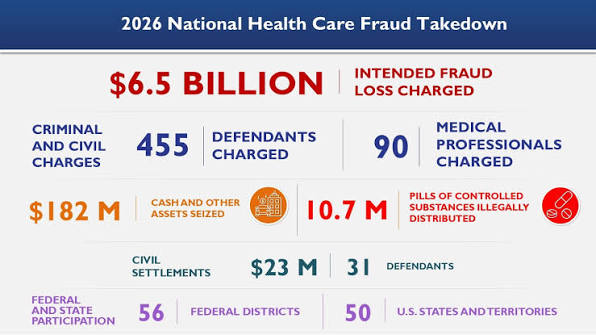
The Justice Department charged 455 people this month with submitting more than $6.5 billion in fraudulent health care claims, the largest coordinated health care fraud takedown in the program’s 19-year history. Ninety of those charged are doctors, nurses, or other licensed medical professionals. But the fallout from a takedown this size doesn’t land on one group of people. It splits differently depending on who you are: a taxpayer, a patient, a person the schemes specifically targeted, or a business owner trying to run an honest clinic next door to one that wasn’t.
What does this cost Medicare and Medicaid taxpayers?
The wound care piece of the takedown alone involved 11 defendants who billed Medicare roughly $4 billion for donated skin substitutes known as allografts, and Medicare actually paid out about $2 billion of it before investigators caught up. Prosecutors say the products were marked up as much as 2,000 percent, with roughly 40 percent of the billed amount funneled back to providers as kickbacks. Separately, HHS-OIG opened 25 new actions seeking to recover $10 billion for the Medicare Trust Fund, the pool of payroll-tax money that covers hospital and medical bills for everyone on Medicare. Every dollar clawed back is a dollar that didn’t have to come from higher premiums or future benefit cuts, but the $10 billion figure is what regulators are asking for, not what they’ve collected.
Who are the patients directly harmed?
Some of the cases named this month describe people who were hurt, not just billed. In the cardiovascular testing case out of the Southern District of Florida, prosecutors say a defendant reviewed 63 heart test images in eleven seconds despite signs of an enlarged heart on the scans; a student athlete whose test was allegedly rubber-stamped that way died during basketball practice about 24 days later. In the Eastern District of Pennsylvania, prosecutors say patients calling into a fraudulent opioid refill voicemail line suffered overdoses and deaths. In Alaska, a personal care attendant is accused of billing Medicaid for care never given to a recipient who suffered severe neglect while hospitalized. These aren’t billing disputes. They’re patients whose actual medical care was replaced by paperwork.

Which vulnerable groups were specifically targeted?
Several schemes in this takedown went after people because they were easy to exploit, not just easy to bill. In the Eastern District of Virginia, prosecutors say defendants paid homeless people in hotel bribes for their Medicaid numbers as part of a $49 million scheme. In Arizona, a $44 million behavioral health fraud primarily targeted Native American Medicaid enrollees. In the Eastern District of New York, eight defendants are accused of running a $38 million scheme billing for social adult day care services at facilities licensed for 30 people that allegedly served hundreds a day, mostly elderly Medicaid recipients. None of those patients chose to be marks. Their eligibility for a public benefit is what made them targets.
What happens to honest health care businesses competing against this?
A wound care clinic billing Medicare honestly for allografts can’t compete with one billing at a 2,000 percent markup and kicking back 40 percent of it to referring providers, because the fraudulent operation can afford to pay more for referrals and still profit. The same dynamic shows up in hospice, behavioral health, and durable medical equipment, all sectors named in this takedown. CMS suspended 1,079 providers and revoked billing privileges for 1,403 more as part of the enforcement action, which also removes fraudulent competitors from the market. But legitimate providers in those specialties absorb reputational damage by association, and some Medicare Advantage plans respond to a fraud wave by tightening prior authorization on the entire category of service, honest billers included.
What comes next
Court proceedings for the 455 defendants will play out over the next year across 56 federal districts. Some defendants named in the takedown, including alleged masterminds of billion-dollar telemedicine and genetic-testing schemes, are still fugitives believed to be overseas. The $10 billion in sought Medicare Trust Fund recoveries and the $73 million already reached in civil settlements will move separately from the criminal cases, on their own slower timeline.
Sources: U.S. Department of Justice, Office of Public Affairs · U.S. Attorney’s Office, Eastern District of Michigan · HHS Office of Inspector General · DOJ Criminal Division case summaries