
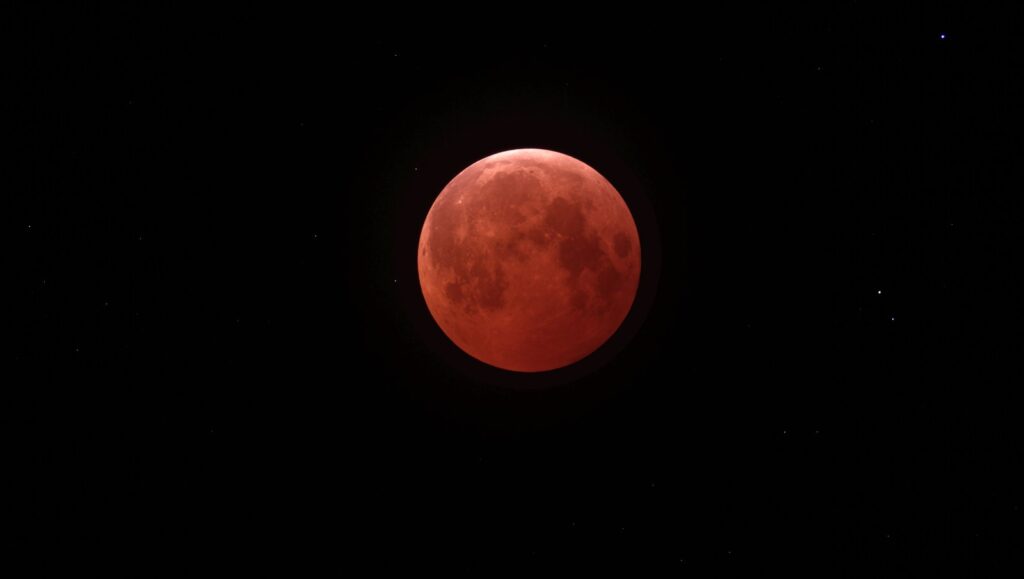
A deep partial lunar eclipse peaked in the early hours of August 28, covering roughly 96% of the Moon’s face and turning most of it a deep copper-red, alongside this month’s Sturgeon Moon, the year’s full moon in August.
Not Quite a Total Eclipse, But Close
Because a sliver of the Moon stayed outside Earth’s umbral shadow, this wasn’t technically a total eclipse or true “blood moon,” but at 96% coverage it was the most dramatic lunar eclipse visible until the total eclipse spanning December 31, 2028, into January 1, 2029. Maximum eclipse hit around 12:12 to 12:13 a.m. ET (04:12 UTC), just minutes before the Sturgeon Moon itself reached its full phase.
Where It Was Visible
The eclipse was visible across much of North and South America, Europe, and Africa. East Coast and Midwest U.S. viewers caught the full sequence, while West Coast observers saw only the later stages as the Moon rose. No special equipment was needed to see it, though binoculars or a small telescope sharpened the color and the thin bright edge that remained uneclipsed.
How Long It Lasted
From first penumbral contact to the eclipse’s end, the full event stretched more than five hours. Skywatchers with an unobstructed view toward the southern or southwestern horizon got the clearest look at the Moon’s shift into deep red.
Related from BeezLoop: NASA's Roman Space Telescope Launches; Trump Calls In to Congratulate Team, Novartis Heart Drug Fails Late-Stage Trial, Dragging Down Amgen and Eli Lilly Shares and OECD's PISA 2025 Report Finds Teen Reading and Math Scores at Record Low Worldwide.