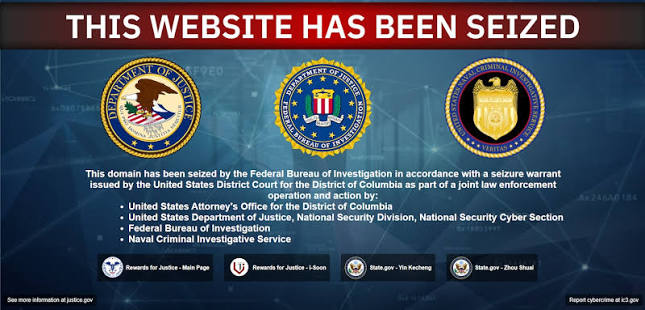
The Justice Department and FBI seized the domains behind two hacking platforms built by a Chinese state-sponsored group, disrupting infrastructure that had been used to target U.S. government agencies and critical infrastructure for years, officials announced August 26.
What Was Seized
The tools, known as QScan and QTRouter, were developed by a group tracked as QTFY, which court documents tie to a Nanjing-based company. QScan scans and automatically infects internet-connected devices worldwide, feeding them into the QTRouter network, a mix of compromised consumer devices, commercial proxy services, and leased virtual private servers. QTFY routed its hacking traffic through machines outside China, including some planted near the networks it was targeting, to disguise where the activity was actually coming from.
Who Was Targeted
Confirmed victims include NASA, the Federal Reserve, the Department of Energy, the Department of Justice, the Department of Health and Human Services, the National Institutes of Health, and the U.S. Senate, with some of the intrusions dating back to at least 2018.

Official Response
“Today we announced the disruption of a global botnet and hacking platform used by Chinese state-sponsored hackers to target U.S. critical infrastructure,” FBI Director Kash Patel said in a statement announcing the operation.
What Comes Next
Seizing the domains disrupts QTFY’s existing infrastructure, but officials have not said whether any individuals tied to the group have been charged, and state-sponsored hacking groups have historically rebuilt similar infrastructure after previous takedowns. The government has not detailed what specific data, if any, was confirmed stolen from the named agencies.
Why seizing domains matters less than it sounds, and still matters
Taking down QScan and QTRouter does not arrest anyone or end the operation. QTFY’s personnel are outside U.S. reach, and infrastructure of this kind is rebuildable. What a seizure does is impose cost and, more usefully, expose method: court filings describing how the tooling worked are now public, which lets defenders everywhere hunt for the same patterns. The disruption is temporary. The intelligence is not.
The proxy design is the part worth understanding
The architecture described here is the current standard for state-linked intrusion, and it is worth grasping because it explains why attribution is hard and why consumer devices matter. QScan scanned and infected internet-connected devices worldwide, feeding them into QTRouter, a blend of compromised consumer hardware, commercial proxy services, and leased virtual servers. Traffic was then routed through machines outside China, some deliberately positioned near the target networks.
The practical effect is that intrusion traffic arrives looking local and residential. Defenders see connections from an ordinary-looking address in their own region rather than from abroad, which defeats the crude geographic filtering many organizations still rely on. It also means compromised home routers and cameras are not incidental victims; they are the operational infrastructure. Consumer device security is national security infrastructure in a fairly literal sense, which is not how most people, or most manufacturers, treat it.
The victim list and the dates
NASA, the Federal Reserve, the Department of Energy, DOJ, HHS, NIH, and the U.S. Senate, with some intrusions dating to at least 2018. The dates are the uncomfortable part. Several of these networks were accessible for years before this disruption, which raises a question the announcement does not address: what was taken during that window, and has anyone outside the agencies been told?
Related from BeezLoop: Hackers Say They Have the Home Addresses of Almost Every FBI Agent, China Denies Hacking Allegations, Accuses US of 'Smearing' Its Companies and Detroit Man's Own Instagram Brag About a Pistol-Whipping, Complete With Hair Stuck in the….