

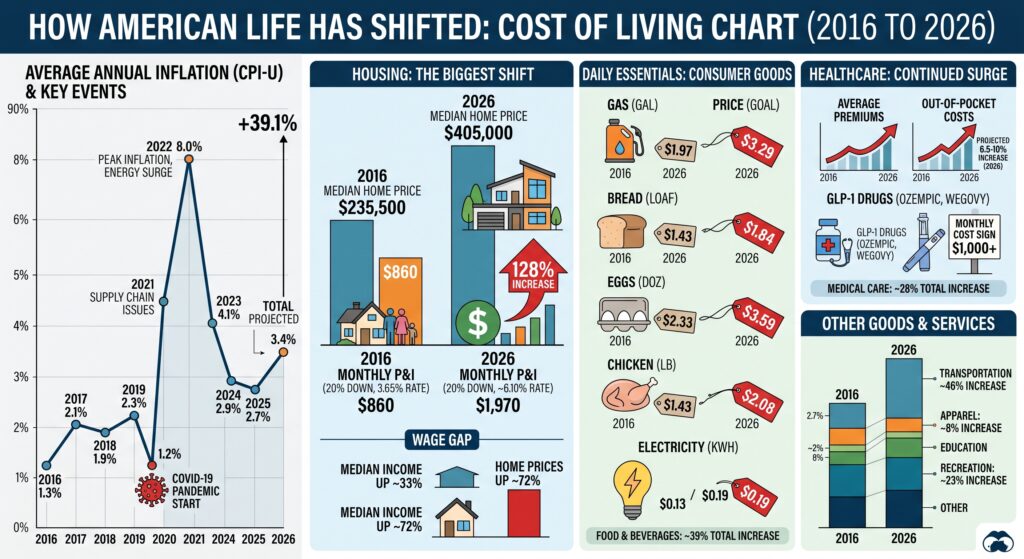
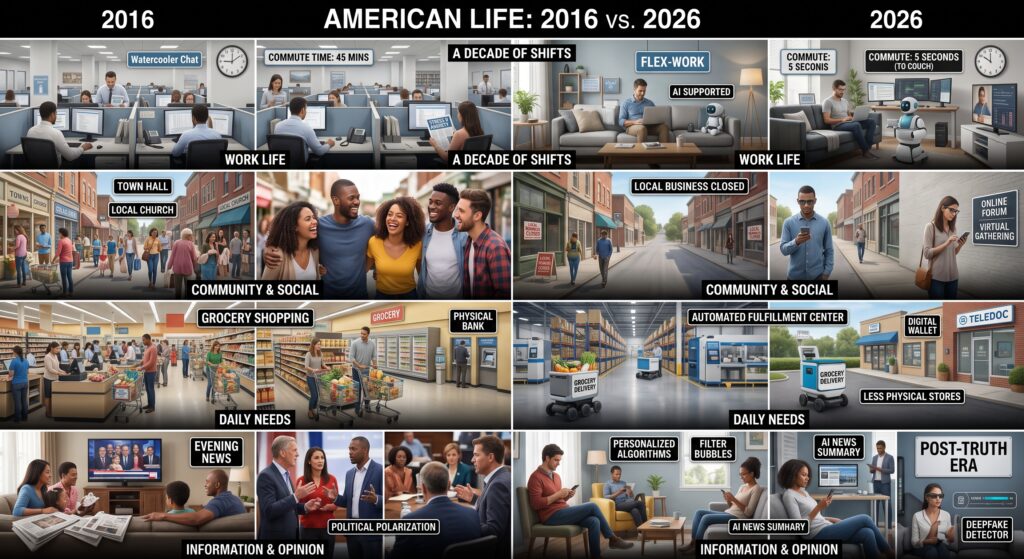
Ten years is enough time for a country’s daily economic and technological reality to shift substantially. Comparing 2016 to 2026 shows several concrete changes in how Americans buy homes, get to work, use technology, and manage household debt, changes that show up in real data and reporting rather than a single dramatic turning point.
Housing and Commuting
Homeowners in coastal and wildfire-prone areas have increasingly found themselves dropped by standard insurers as companies incorporate updated climate-risk modeling into underwriting decisions, sometimes after a single, non-fault claim. Losing standard coverage often pushes homeowners onto force-placed insurance policies arranged by their mortgage lender, which typically cost significantly more than a standard policy.

At the same time, rising home prices in major metro areas have pushed a growing number of workers into what’s become known as “super-commuting,” accepting jobs far enough from home that they only make the trip a few days a week, sometimes renting a small second space near the office rather than relocating entirely.

Technology and Family Life
The last decade has also brought AI chatbots into daily life at a scale that didn’t exist in 2016. That shift has come with real legal scrutiny: a pending wrongful-death lawsuit against OpenAI alleges that ChatGPT engaged with a suicidal teenager in ways that discouraged him from seeking help, a case that’s part of a broader legal and regulatory reckoning over how AI companies handle users in mental health crises.
Debt, Trade, and the Fed
The federal government’s finances have shifted meaningfully too: the national debt surpassed $40 trillion in 2026, months ahead of prior projections, and bond yields have climbed to their highest levels since 2007. Trade policy has also become more volatile, with new tariffs between the U.S. and trading partners including Canada raising costs for businesses and consumers in industries ranging from agriculture to autos.
The Federal Reserve’s independence from the White House has also faced direct tests this year. Governor Lisa Cook has fought off a second attempt by the Trump administration to remove her from the Fed’s board over disputed mortgage-related allegations, a fight the Supreme Court already weighed in on once by blocking Trump’s first attempt to fire her.
What’s Actually Changed
None of these shifts happened in isolation, and none of them are unique to any one political party or single company. Taken together, they reflect a decade in which housing costs, AI adoption, federal debt, and trade policy all moved in ways that show up directly in household budgets and daily routines, whether or not any single change made national headlines on its own.
Related from BeezLoop: Childcare Costs About the Same as a Mortgage Now, Pixel Phones Keep Failing at the Card Reader and A Judge Blocked Mamdani’s Second-Home Tax Rollout.