


Turn on cable news or open any social feed and you’ll see the same story: ordinary people taking political “justice” into their own hands, egged on by strangers online. Commentators tend to treat this as a spontaneous breakdown in civility, a sign the country is coming apart. A closer look at how these moments actually spread points to something less mysterious and more mechanical: the platforms carrying the outrage are built to reward it.
Social platforms make money on attention, and attention is easiest to hold with fear and anger. That’s not a conspiracy theory, it’s just how engagement-based ranking works: posts that provoke a strong reaction get shown to more people, so the algorithm learns to surface exactly the content that provokes the strongest reactions, which tends to be the most alarming version of any story. A local dispute or an isolated act of violence gets stripped of context and reframed as evidence of a much bigger, existential threat, because that framing performs better than the boring, complicated truth.
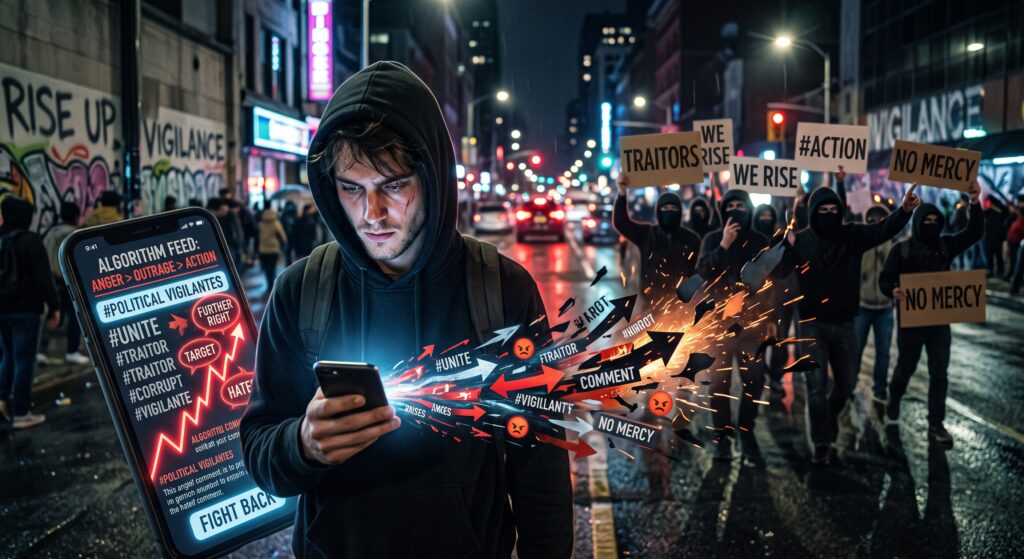
The effect compounds over time. Someone who spends months consuming an algorithmically curated diet of worst-case political content can end up genuinely convinced that institutions have failed and that direct action is the only option left. The platform never explicitly tells anyone to act. It doesn’t have to. It just keeps showing them the version of the world most likely to make them feel like they have no other choice.

The people who build and profit from these systems are, for the most part, insulated from the consequences. The person who acts on that manufactured sense of crisis is the one who ends up facing charges, not the platform that spent months feeding them the content that got them there. And when it happens, the footage becomes content too, another data point to keep the cycle running for the next person scrolling.
None of this makes any individual act of vigilantism less serious, or less someone’s own choice and responsibility. But if the goal is actually understanding why this keeps happening rather than just being alarmed by it, the incentives built into the platforms people spend hours a day on are a much better place to start than a vague story about declining morals.
Related coverage: Science, Nature.
Related from BeezLoop: The Science on Teen Social Media and Mental Health Isn’t as Settled as the Bans Suggest, The "Explore" Page Grift: How Online Outrage Culture Feeds the Algorithm and Exploiting Development: Inside the Federal Trial Over Meta’s Youth Harm Algorithms.