
In the world of corporate-state trade policy, administrators live in a neat, binary fantasy land. They believe that you can draw a thick, red line around a country like China, slap a 60% tariff on their goods, and expect the global economy to politely comply.
But if you apply some raw, street-level common sense, that’s not how the real world works. The real world of global trade is fluid, adaptive, and highly decentralized. It operates like water: when you build a dam, the water doesn’t stop, it simply finds a thousand new cracks to flow through.
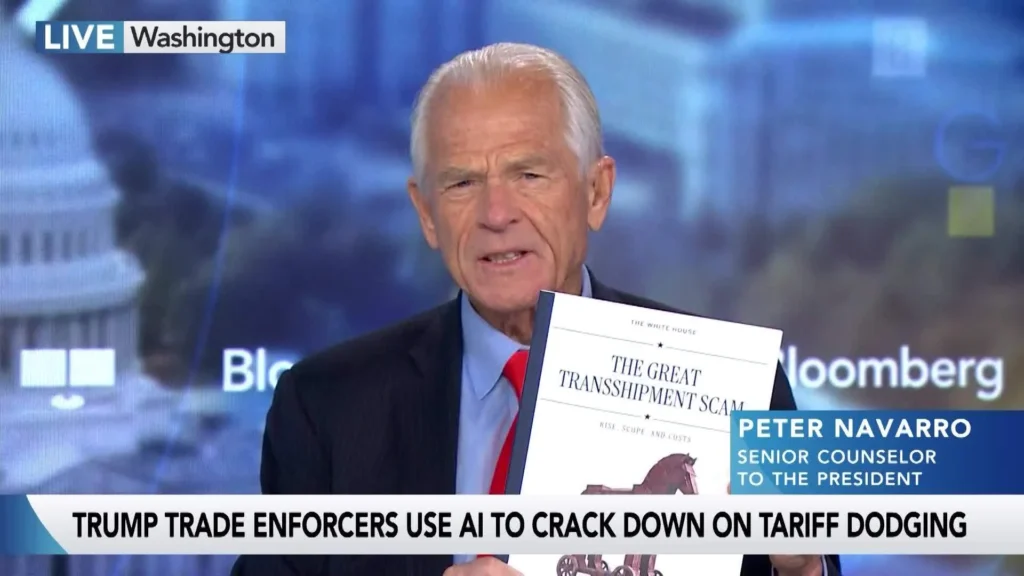
Take a look at the report released by the Trump White House on August 14, 2026: Trade adviser Peter Navarro announced that the United States is losing between $19 billion and $26 billion annually in tax revenue. The culprit? What Navarro calls the “Shadow Transshipment Network.”

According to the report, China has spent years dodging U.S. tariffs by routing its exports through more than 40 third-party nations, including many of America’s largest trading partners, such as Mexico, Canada, India, Malaysia, and the European Union. A product is manufactured in Shenzhen, shipped to Vietnam or India for “re-packaging” or minor assembly, and then stamped with a fresh “Made in India” label before entering the U.S. tariff-free.
To combat this, Navarro revealed that Customs and Border Protection is prototyping artificial intelligence to analyze shipping manifests and detect transshipments. Furthermore, the administration is weighing trade penalties and tariff rollbacks on key partners like India that “enable” this laundering.
Let’s look at this AI-powered crackdown with some independent logic.
First, the idea that you can solve a systemic, multi-billion-dollar economic flow with an AI algorithm is peak bureaucratic techno-hopium. You can build the most advanced predictive model in the world, but as long as there is a significant price arbitrage between a Chinese-made motor and an American-made one, exporters will find a way to package it, launder it, and ship it.
Second, threatening to penalize strategic allies like India, Mexico, and Canada is a risky bet. These countries aren’t “helping China” out of ideological solidarity; they are participating in a globalized, highly integrated supply chain. If you slap anti-transshipment penalties on India or Mexico, you aren’t just hurting China, you are directly raising the cost of raw materials for American manufacturers and driving up the price of basic household goods for the everyday consumer.
We are watching a high-tech game of tariff whack-a-mole. The political class in Washington wants to pretend they are “bringing manufacturing back” by declaring war on international logistics, while the American consumer is left to foot the bill for their geopolitical theater.