

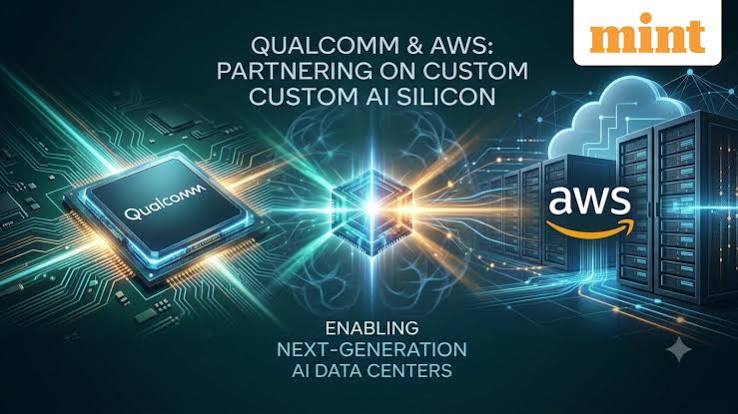
Qualcomm and Amazon announced a multi-generational partnership on Tuesday to co-develop custom AI chips for Amazon Web Services data centers, a deal that sent Qualcomm shares up roughly 10 percent and positions the chipmaker as a fresh challenger to Nvidia in the data center market.
The agreement covers multiple generations of custom silicon focused on AI inference workloads, pairing Amazon’s data center infrastructure expertise with Qualcomm’s experience building power-efficient processors. The deal also includes performance-vesting equity warrants that let Amazon acquire up to 25 million Qualcomm shares, tied to potential hardware purchases worth as much as $60 billion through 2036.
Why does Amazon need another chip supplier?
Amazon already designs its own AI chips, Trainium and Inferentia, through its Annapurna Labs unit, but demand for AI computing capacity has outpaced what any single chip program can supply. Bringing in Qualcomm gives AWS a second custom-silicon track and reduces its dependence on Nvidia GPUs, which remain in short supply and carry high margins that cut into cloud providers’ profitability.

The partnership also covers optical interconnect technology supporting data rates up to 1.6 terabits per second, with room for future upgrades, and Qualcomm says it will use AWS tools including Amazon Bedrock to speed up its own chip-design workflows.
What does this mean for the AI chip market?
Qualcomm has built its business primarily around smartphone processors and has spent recent years trying to diversify into automotive and PC chips. A foothold in AI data centers marks a significant expansion into a market currently dominated by Nvidia, with AMD, Broadcom, and various in-house cloud provider chips also competing for share.
Analysts said the warrant structure signals confidence on Amazon’s part that the partnership will produce chips it wants to buy at scale, while giving Qualcomm a committed customer to justify the investment required to enter a market with steep technical barriers.
Sources: Bloomberg · Seoul Economic Daily
Related from BeezLoop: The Bipartisan Rebellion Against Big Tech's Water-Gulping, Power-Grid-Squeezing AI Factories, 7 in 10 Americans Don't Want a Data Center Near Them and AI Is Booming.






[…] on BeezLoop: Qualcomm and Amazon’s multi-year deal to build custom AI data centers, and why 64% of Americans say AI is moving too […]