

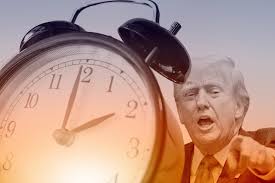
The Annual Anxiety
It happens every single year. Right around August, the annual clock-watching anxiety begins to tick upward. Thousands of people frantically search Google: “Will clocks fall back on Nov. 1?” and look for updates on the perpetually stalled Sunshine Protection Act.
We are living in the year 2026, an era of reusable space rockets, quantum computers, and automated medical breakthroughs. Yet twice a year, the entire nation is forced into a bizarre, mandatory ritual of collective time-travel, arbitrarily moving the hands of our clocks because of an outdated, 100-year-old agrarian policy.
A Biological Tax
Let’s look at this with some basic, common-sense logic. Every single time we “fall back” or “spring forward,” the real-world consequences are devastatingly consistent.

Our biological circadian rhythms are instantly disrupted. Sleep deprivation spikes, workplace accidents increase, heart attacks rise, and the evening commute is suddenly plunged into darkness, leading to a predictable wave of traffic accidents.
It is a biological tax levied on the entire population for absolutely no logical reason.
Frozen in Gridlock
So why are we still doing it? Because the federal establishment is so utterly frozen in partisan gridlock and bureaucratic red tape that it cannot even pass a simple, common-sense law to stop changing the clocks.
The Sunshine Protection Act, a rare piece of legislation that almost every single everyday American actually agrees on, has been bounced back and forth between congressional committees for years, dying a quiet death under a mountain of administrative excuses.
Can’t Even Fix a Clock
It is the perfect metaphor for modern governance: an establishment so thoroughly bogged down by corporate lobbying, procedural nonsense, and theater that they can’t even fix a clock.
If we can’t trust our leaders to solve a simple, logical issue like daylight saving time, how can we trust them to manage a federal budget, reform healthcare, or protect our economy?
It’s time to stop the clock game, lock the time, and let us get on with our lives.