

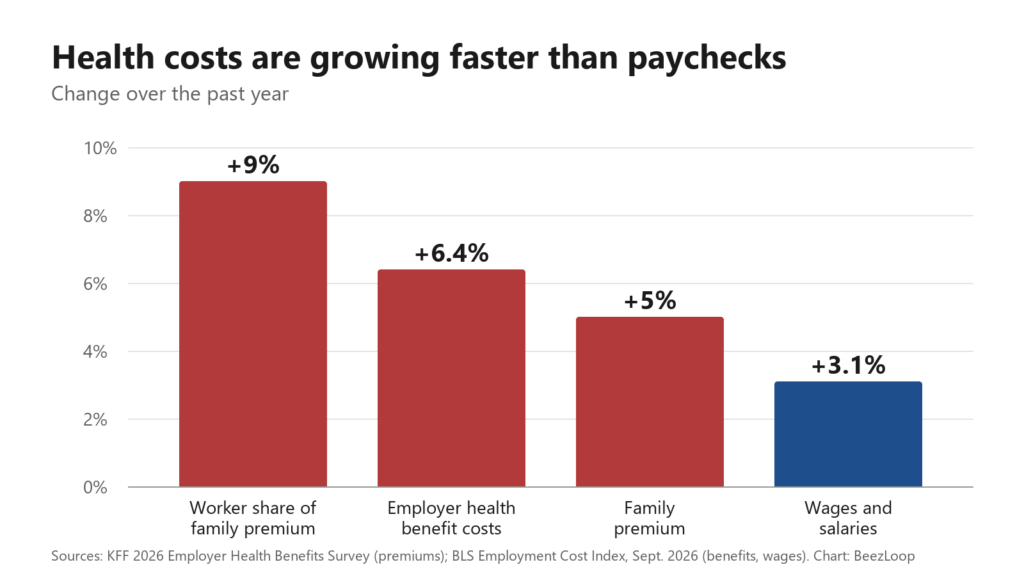
The average family health plan through work now costs $28,303 a year, up 5%, and workers’ share of it rose 9% to $7,471, according to KFF’s 2026 employer survey. Paychecks didn’t keep up: wages and salaries rose 3.1% over the year through September, while what employers spend on health benefits rose 6.4%, the Bureau of Labor Statistics reported.
That gap is why a raise can feel like a pay cut. Here’s where the money is going, and what you can do about it.
How fast are health care costs rising compared to wages?
- Your share of a family plan: $7,471 a year, up $621, or 9%.
- Total family premium: $28,303, up 5%. Single coverage costs $9,804, also up 5%, with workers paying $1,672.
- Employer health benefit costs: up 6.4% in the private sector over the year, roughly double wage growth.
- Wages: up 3.1%. After inflation, private-sector wages actually fell 0.6%, per BLS.
- Over five years: family premiums rose 28%, a bit faster than wages (26.9%) and inflation (24.4%), KFF found.
Even when employers pick up most of the bill, you still pay for it. Money your company spends on rising premiums is money it doesn’t put into raises.

Why are health insurance premiums going up so fast?
Mostly prices, not people going to the doctor more. Since 2016, prices for hospital services have risen 57% and home health care 62%, outpacing overall inflation of 42%, according to the Peterson-KFF Health System Tracker. Hospital mergers give big systems more power to charge insurers more, and new drugs and expensive treatments add up.
One honest caveat: over the past 12 months, consumer medical prices rose only 1.5%, slower than overall inflation of 3.7%, per the same tracker. The squeeze is showing up mostly in premiums and in how much of them employers are shifting onto workers.
What about ACA marketplace plans?
It’s worse there. Benchmark silver plans on the ACA marketplaces are rising 13% on average for 2027, after a 26% jump this year, KFF found. Enrollment fell 12% this year, to 19.2 million people. Open enrollment for 2027 coverage is underway now.
How can you lower your health insurance costs?
- Compare plans at open enrollment instead of auto-renewing. A higher-deductible plan with a health savings account can cost less if you’re healthy.
- Check marketplace subsidies at HealthCare.gov or your state’s exchange; eligibility depends on income.
- Ask for cash prices and use in-network care. Out-of-network bills are where many families get hurt.
- Use an FSA or HSA to pay medical costs with pre-tax dollars.
Health costs are now a political fight too: Michigan’s senator-elect just offered Trump a universal health plan branded “TrumpCare.”
The squeeze is hitting other budgets too: Social Security checks rise 3.6% in 2027, and 760,000 people were cut from ACA plans this year.
The BeezLoop Take
Workers are paying 9% more for family coverage in a year when their wages grew about 3%. That’s not a blip; KFF says premiums have outrun earnings in most years since the late 1990s. Both parties talk about affordability, but the biggest single driver, what hospitals and drugmakers charge, keeps getting a pass.
Washington is fighting over what to call a health plan. When does anyone take on what health care actually costs?
Sources: KFF 2026 Employer Health Benefits Survey · BLS Employment Cost Index · KFF: 2027 ACA open enrollment · Peterson-KFF Health System Tracker · KFF (video)