
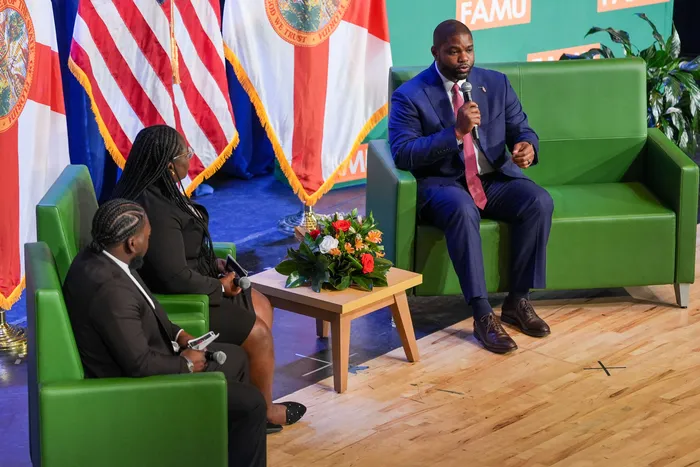
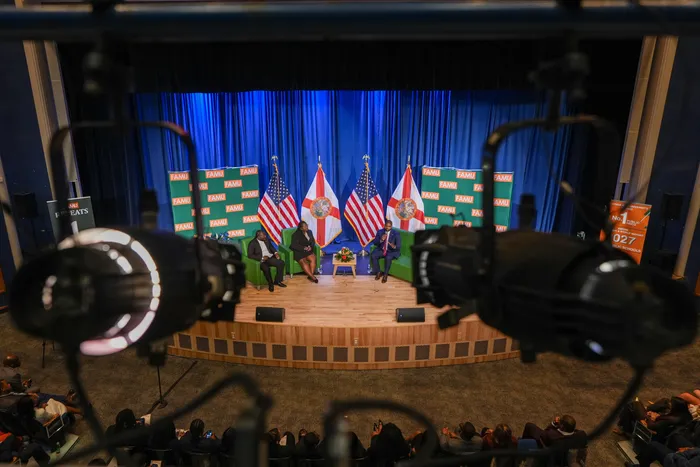
Byron Donalds went to Florida A&M, one of the country’s most prominent historically Black universities, to talk to student voters. His campaign banned all recording. No audio, no video, no signs. Then somebody pulled the fire alarm.
What happened?
- Donalds, the Republican nominee for governor of Florida, held a town hall at FAMU in Tallahassee on Tuesday.
- The event was originally meant to be a debate with Democratic opponent David Jolly. That was scrapped.
- The campaign permitted no recording of any kind, audio or visual, and no signs.
- Attendance was limited to currently registered FAMU students, with others needing to request permission from an organizer.
- Exchanges got heated over 287(g) immigration agreements and critical race theory.
- A fire alarm went off around 8:59 p.m. The event was scheduled to end at 9. One student said there was obviously no fire and someone had pulled it.
What 287(g) is
One line, because it was the flashpoint. A 287(g) agreement lets local law enforcement perform certain federal immigration enforcement functions. Florida has pushed them aggressively, including onto university campuses, and students wanted to know where Donalds stands.
The BeezLoop Take
Banning recording is the whole story and it should not be buried under the fire alarm. A candidate for governor went to a public university, in a state where he is asking Black voters to consider him, and made it a condition that nobody could document what he said.

There is no good version of that. If the answers were solid, recording helps him, and campaigns normally beg for footage of a Republican getting a fair hearing at an HBCU. The only rational reason to bar every phone in the room is an expectation that something would happen you would not want circulated. He ran a closed event and then held it up as outreach.
The scrapped debate makes it worse, not better. This was supposed to be Donalds and David Jolly on the same stage. Instead it became a solo appearance under rules the campaign wrote, with an audience filtered through a permission process, and no record. That is not a town hall. It is a private meeting with a press release attached.
We would apply the same standard to a Democrat, and the test is easy to state: a candidate who will not let you record an answer is telling you what he thinks of the answer. Any campaign, either party, that bars recording at a public university event should be covered as a campaign that did that.
Whoever pulled the alarm did him a favor and should not have. It gave the campaign a grievance and a clip, and it handed every story about the event a more entertaining lede than the recording ban. One minute before the scheduled end, it also changed nothing.
What did Byron Donalds say at FAMU that his campaign did not want recorded?
What did Byron Donalds say at FAMU that his campaign did not want recorded? And why did a scheduled debate with his opponent turn into an event where he set the rules?
Related: Byron Donalds won his primary on Trump’s endorsement, then took it off his homepage.
Sources: WCTV · Raw Story · Cassius Life · Florida A&M University