

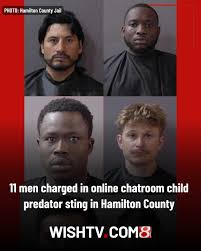
Eleven men drove to the Westfield area over three days in September expecting to meet children for sex, according to Indiana investigators. Undercover officers were waiting at every one of them.
What happened
The operation ran September 22 through 24 and was carried out by the Hamilton County Internet Crimes Against Children Metro Task Force, working with police departments from Greenwood, Westfield and Lebanon.
Investigators say the men communicated online with people they believed were underage girls and then drove to the Westfield area to meet them. Police say the purpose was sex with children. Officers arrested them on arrival.

Preliminary charges across the eleven vary, ranging from child solicitation to sexual misconduct with a minor and dissemination of harmful material to a minor. These are preliminary charges and no one has been convicted.
Who runs this
The task force is headquartered at the Fishers Police Department and pulls detectives from Carmel, Fishers, Greenfield, Westfield, Noblesville, Anderson, the Hamilton County Sheriff, the Madison County Sheriff and the Department of Homeland Security.
That structure is the point. No single suburban department has the staff to run a 72-hour undercover online operation and also handle the digital forensics behind it. Pooling detectives across nine agencies is the only way a county like Hamilton fields this at all.
The BeezLoop Take
Eleven men in three days, in one suburban county, is the number to sit with. That is not a sweep that had to look hard. Investigators put up decoys and eleven adults drove to meet them inside a single long weekend, which tells you the supply of people willing to do this is deep enough that the limiting factor is how many officers you can spare.
These operations work and they also raise a fair question that supporters should answer rather than dodge: every one of these arrests is a crime that law enforcement constructed the opportunity for. That is legal, it is long-established, and Indiana courts have upheld it. It is also why the charges here matter more than the headline. A conviction has to survive an entrapment defense, and the ones that hold up are the ones where the defendant escalated on his own. The reporting that matters in six months is how many of these eleven plead and how many walk.
The multi-agency structure deserves more attention than it gets, because it is the actual policy story. Nine agencies including DHS pooled to run one 72-hour operation in one county. Most of rural America has nothing like this. The same men, doing the same thing, in a county without a funded ICAC task force, meet nobody and get arrested never. The difference in outcome is not the offender, it is the budget.
And parents should take the specific detail seriously rather than the general alarm. These men did not lurk in a park. They met kids on the same messaging apps and social platforms your children already use, moved the conversation somewhere private, and then drove. The intervention point is not the parking lot in Westfield. It is who your kid is talking to on a phone in the next room.
The question
If eleven men turn up in one county over one weekend, what is the number in counties that cannot afford a task force? And how many of these eleven cases survive to a conviction?
Related: a Texas principal allegedly told a job applicant to change his name to beat a background check, and Chris Hansen reviewed the movie about Chris Hansen.
Sources: WISH-TV · WTHR · Current Publishing · Indiana ICAC Task Force