
Lucid is putting its Gravity SUV into a robotaxi fleet with Nuro and Uber. Meanwhile the luxury car you might actually buy has more synthetic material in it than it used to and costs more than it did. Those two facts are related.
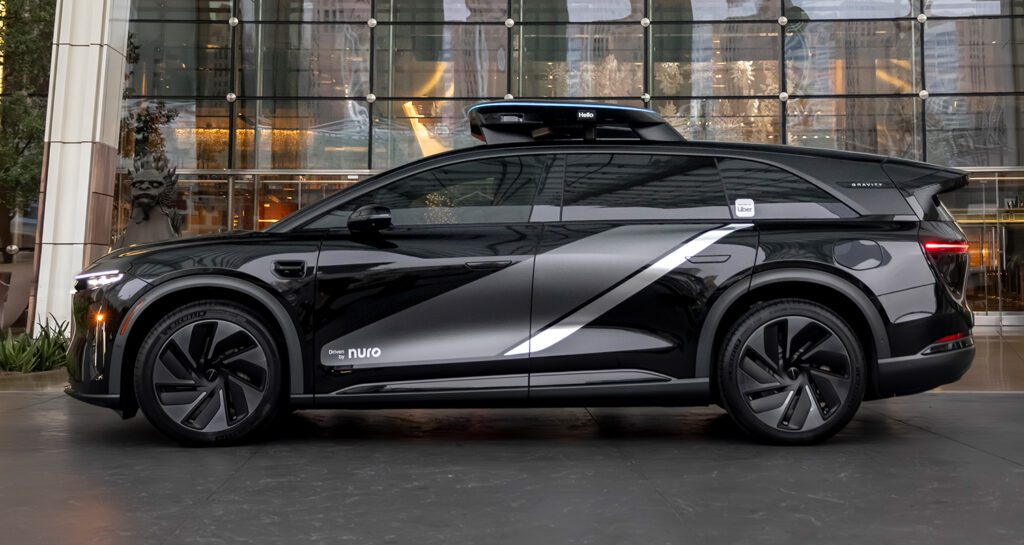
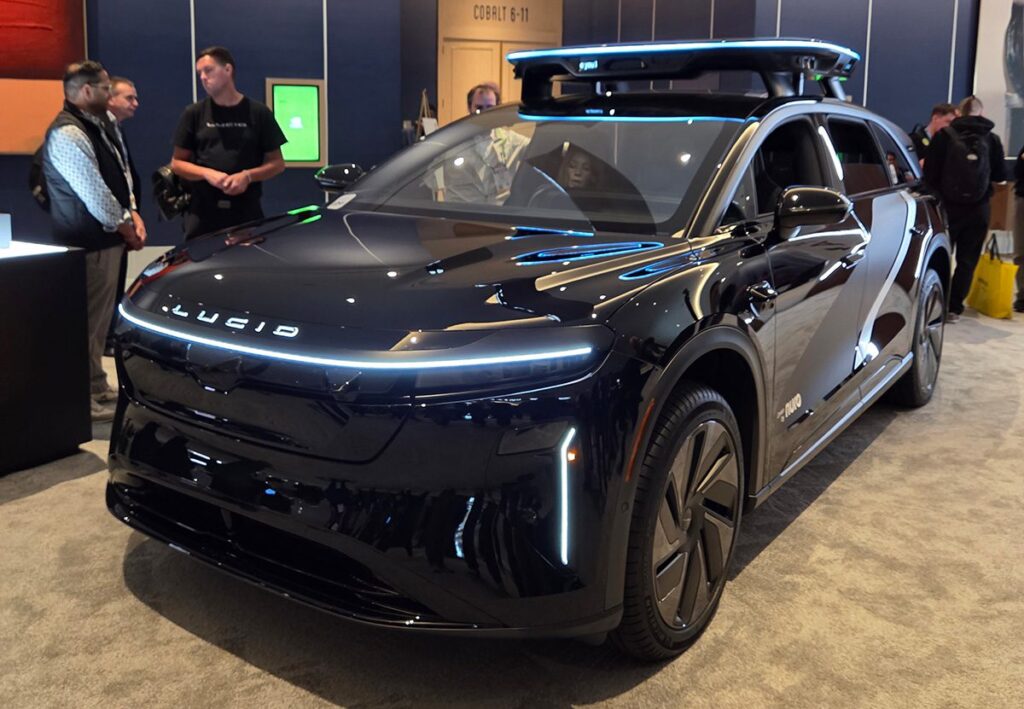
The robotaxi
The partnership is three companies doing three jobs. Lucid supplies the Gravity and its vehicle architecture. Nuro supplies the Nuro Driver, a Level 4 autonomy system. Uber supplies the network, the app and the fleet management.
- Target of 20,000 or more Lucid vehicles over six years.
- Announced target of first rides in a major US city late in 2026. Lucid’s own August guidance points later. See below.
- Available exclusively through the Uber app.
- Autonomous on-road testing began in December 2024.
- Production-intent vehicles and the Uber-designed cabin were shown at CES 2026.
- Uber plans multi-hundred-million dollar investments in both Nuro and Lucid.
Level 4 means the vehicle drives itself within a defined area and set of conditions, with no expectation that a human takes over inside that envelope. It is not the same as a car that can go anywhere.

What Lucid has said since the announcement
This is the part that matters more than the CES presentation, and it points a different direction.
On August 4, reporting its second quarter, Lucid announced what it calls an operational reset. Per the company’s own release and CNBC’s account:
- Non-prototype robotaxi production begins early next year, meaning 2027, not this year.
- Production-Validation Gravity vehicles have been delivered, with Uber and Nuro testing across the San Francisco Bay Area and Houston.
- The midsize vehicle slips to most likely the second half of 2027.
- A $1.4 billion cash flow improvement plan is underway.
So the launch language and the production language do not line up. A limited service could still put riders in cars before January while the vehicles actually built for the job arrive later. Anyone reading late 2026 as a fleet on the road is reading the press release, not the guidance.
The company doing this
Lucid is not a steady operation executing a plan.
Silvio Napoli became chief executive on June 1, 2026, after a career at Schindler Group. He replaced interim CEO Marc Winterhoff, who returned to chief operating officer and reports to him. Winterhoff had been interim since founder-CEO Peter Rawlinson stepped down in February 2025.
Napoli’s framing of what he inherited was not gentle.
Lucid has leading technology, compelling products and deeply committed people, but potential is not performance.
Silvio Napoli, CEO, August 4
He said the company is going back to basics with a focus on cash, customers and culture.
The second quarter numbers say why. Revenue rose to $405.34 million from $259.43 million a year earlier. Loss from operations widened to $1.08 billion from $803.04 million.
Revenue up, losses up faster.
Why a luxury EV for a taxi
It looks like a mismatch and it is not.
A robotaxi runs far more miles per year than a private car, so durability and low running costs matter more than sticker price. An electric drivetrain has fewer things to wear out. And a vehicle built around software from the start is much easier to fit with an autonomy stack than one that had computers added later.
The luxury part is also doing marketing work. Uber is betting people will pay a premium for a nicer robotaxi, which is a more comfortable proposition than competing purely on price.
The other thing happening to cars
While that is being built, the ordinary new-car market is going a different direction.
Interiors have moved away from leather toward synthetic alternatives, marketed as progressive and sustainable. Mercedes-Benz made the electric GLC its first vehicle with The Vegan Society trademark, with animal-free interiors reaching US customers in the second half of 2026.
Some of that is genuine. Some of it is plastic with better vocabulary, and it is cheaper to produce than the hide it replaced.
Prices have not followed the materials down:
- BMW raised MSRP roughly 2% across many 2026 models, about $1,100 to $2,500 more.
- The new Tesla Model Y arrived with a smaller battery, a less powerful motor, and no ambient lighting or rear touchscreen.
- Not everything went up. The Cadillac Lyriq is expected to drop $2,000 to $3,000, and the BMW iX by as much as $8,000 off an $88,425 MSRP.
And financing is its own increase. With the 10-year Treasury at 5.12%, the loan costs more even when the car does not.
The BeezLoop Take
Decontenting is the word the industry does not use and it is the right one. When a company removes ambient lighting and a screen and keeps the price roughly where it was, that is a price increase that does not appear as a price increase. The Model Y example is unusually blatant but the practice is everywhere, and it is why people who feel like they are getting less for more are not imagining it.
The vegan leather story deserves a harder look than it gets, and this is where we part from the reflexive green read. Replacing animal hide with polyurethane is not obviously better for the planet, it does not last as long, and it costs less to make. A company can be sincere about animal welfare and still be enjoying a margin improvement it describes as an ethical choice. Buyers are entitled to know which one they are paying for.
That said, the doom framing is also wrong. Real luxury EVs got cheaper this year. An $8,000 drop on a BMW iX and a few thousand off a Lyriq are not rounding errors, they are a market correcting after overpricing electric vehicles for years. Anyone claiming everything only goes up is not looking at the segment.
On the robotaxi, the number to be skeptical about is 20,000 over six years, and the skepticism now has a source. Lucid lost $1.08 billion from operations in a single quarter, is running a $1.4 billion cash reduction plan, has a CEO four months into the job who says potential is not performance, and told investors in August that non-prototype robotaxi production starts in 2027. A company in an operational reset promising 20,000 autonomous vehicles is not lying, but it is describing a destination while it fixes the engine. Testing in the Bay Area and Houston is real progress. It is not a fleet, and the gap between the CES timeline and the earnings timeline is the most honest thing in this story.
The part nobody in the announcement addresses is who drives for a living. Uber is investing hundreds of millions in removing its own drivers, and describing it as a rider experience upgrade. That may well be where the technology goes and it is not a reason to stop building it. But a company should be made to say the quiet part, because the people whose income depends on that app deserve more than a press release about cabin design.
The question
If a car has a smaller battery, fewer features and cheaper materials than last year’s at the same price, is that a price increase? And when Uber spends hundreds of millions to replace its drivers, what does it owe them?
Related: Rivian recalling 98,828 vehicles and Tesla opening its Semi plant, and the borrowing costs behind every car payment.
Sources: Lucid Group investor relations · Nuro · CBT News · CarEdge on 2026 pricing · Motor1