
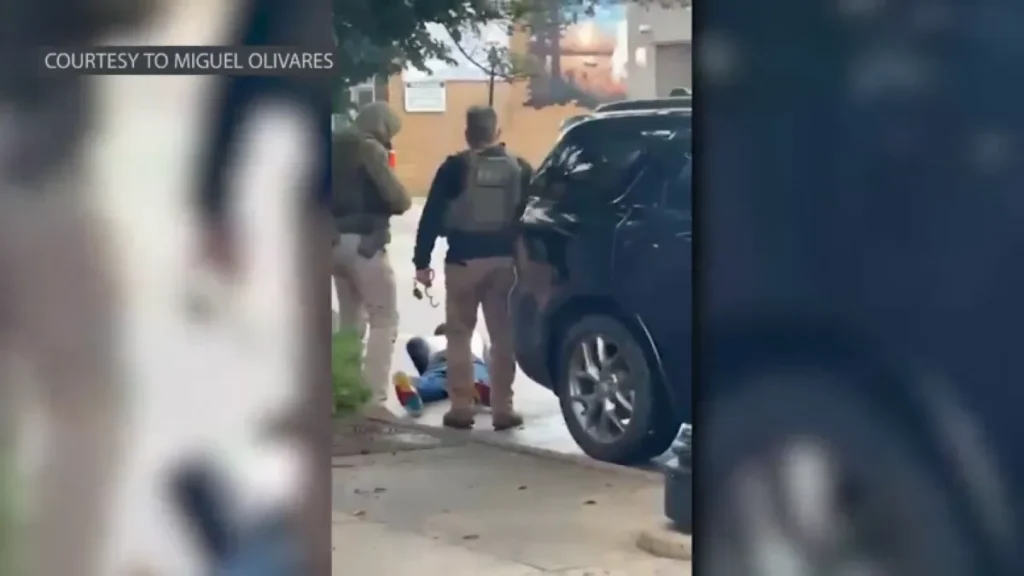
Federal agents in Evanston, Illinois pinned a man to the ground, hit him in the face, and left him with injuries to his head, neck and teeth. Then they figured out he was not the person they were looking for and let him go.
He is a US citizen.
What happened Sunday morning
Evanston police were dispatched around 9:49 a.m. on a report of two men arguing near Howard Street and Dodge Avenue.

What they found was a federal immigration operation. An agent told the responding officers that five agents in separate vehicles were looking for a fugitive with a Chicago address and an arrest warrant.
The account the agents gave police was this: they spotted someone who resembled the man they wanted, he refused to provide identification, they detained him to take fingerprints, and he resisted.
The account of what that detention looked like is harder. Officers described the man pinned against the ground, handled roughly, and struck in the face. An ambulance was called. He reported injuries to his head, neck and teeth.
One line from the scene has traveled further than any of the paperwork.
I’m a f**king US citizen.
The man detained, as reported by CNN
The fingerprints came back. He was not the fugitive. He was released.
How it ended
Protesters showed up. The federal agents left the area, telling local police they were concerned about being attacked.
Evanston police are investigating. The man has not been publicly named and we are not naming him.
Why refusing ID is the center of this
The agents’ own account leans on it, so it is worth being precise.
Illinois has no stop-and-identify law requiring a person to hand over papers on demand. A citizen who declines to identify himself to a federal agent on a public street in Evanston is not committing a crime by declining.
That does not make the agents’ job easy. If you are hunting a specific person with a warrant and the man in front of you matches and will not confirm who he is, you have a real problem.
But the cost of that problem landed entirely on the man who turned out to be innocent.
The pattern this fits
Evanston is not an isolated week for federal enforcement in this country.
An ICE agent shot a DoorDash driver in Austin on September 20, the same day as Evanston. The man said there was no foot chase.
A Fox News poll this month found 53% of voters saying enforcement has gone too far, with independents at 60%.
And the public appetite for these stories has gotten ahead of the facts more than once. A video about a fence crew and ICE drew 17 million views on a claim the man who filmed it says never happened. That is why the paperwork matters here, and why the Evanston police report is worth more than the clip.
The BeezLoop Take
Start with what is not in dispute. Five federal agents went looking for one man with a warrant. They grabbed somebody else, hurt him badly enough to need an ambulance, confirmed through fingerprints that they had the wrong person, and released him. Every part of that is in the account the agents themselves gave local police.
The refusal to show ID is the hinge, and it is being used to do more work than it can hold. In Illinois a citizen is allowed to decline. That is not obstruction, it is the law, and an agency that finds the law inconvenient does not get to treat compliance as the price of not being injured. If refusing to identify yourself is what converts a case of mistaken identity into a trip to the hospital, then the protection against unreasonable detention is worth nothing to anyone who exercises it.
There is a real operational problem underneath, and pretending otherwise would be dishonest. Agents hunting a fugitive who has a warrant, facing a man who matches the description and will not confirm his name, are in a genuinely hard spot. The answer to that is better identification before the takedown, not more force during it. Five agents in five vehicles had the resources to be sure.
What should trouble people regardless of where they land on immigration is the accountability gap. Evanston police are investigating a federal operation they did not run, over which they have no authority, involving agents who left the scene. There is no obvious body that answers for this. The man has injuries, no charges, no arrest record, and no clear door to knock on.
The agents leaving because they feared being attacked is worth noting too, and not as a punchline. That is a description of an enforcement agency operating in a community where it expects hostility, doing work that generates more of it every time something like this happens. Whatever anyone thinks the right immigration policy is, this is not a sustainable way to carry one out.
The question
If a citizen is legally allowed to refuse to show ID, what is supposed to happen next when agents think he might be their man? And who does he complain to now, given that the officers investigating do not have authority over the agency involved?
Sources: CNN · Evanston RoundTable · ABC7 Chicago · The Hill