
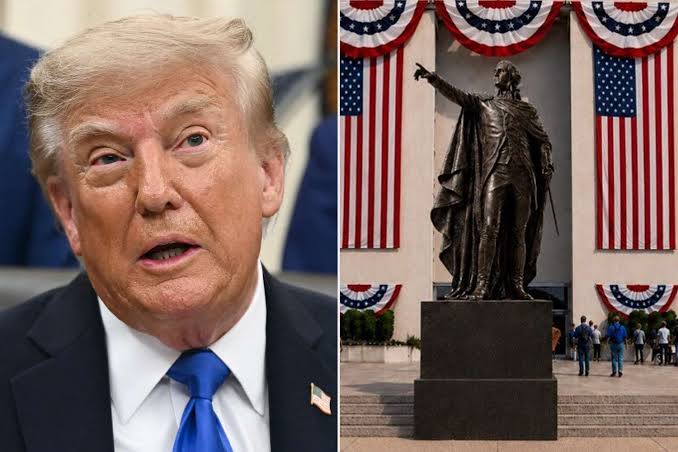
Trump’s demand that the Smithsonian replace a modernist sculpture outside the National Museum of American History with a giant statue of George Washington comes to a head Thursday, when he wants an 11-foot Washington statue installed inside the museum in time for Constitution Day. As of this week, the Smithsonian hasn’t publicly said whether it will comply.
What exactly is Trump asking the Smithsonian to do?
Trump wants two separate additions. First, an 11-foot Washington statue, the same one recently featured at the Freedom 250 IndyCar race, installed in the museum’s Flag Hall by Constitution Day on September 17. Second, and more dramatically, a 30-foot “Colossus statue” of Washington installed outside the museum’s south entrance, replacing “Infinity,” a kinetic sculpture by artist José de Rivera that the federal government commissioned and dedicated at that spot back in 1967. Trump has also asked for a Washington-focused exhibition to run continuously from now through February 22, 2032, the 300th anniversary of Washington’s birth.
Why is Trump targeting this specific sculpture?
Trump has called “Infinity” a “strange modernist sculpture” that “tells visitors nothing about America, inspires no one, and honors none of our Great American Heroes.” That framing fits a broader pattern rather than a one-off complaint: for more than a year, Trump’s administration has clashed with the Smithsonian over claims that its exhibitions present an unflattering view of American history, criticism outgoing Smithsonian Secretary Lonnie G. Bunch III has consistently rejected, saying the institution’s exhibitions are grounded in rigorous scholarship rather than ideology.

Why does the timing matter here?
Trump’s demand landed just days after Bunch announced his retirement, handing the administration a real opening to reshape Smithsonian leadership and priorities at exactly the moment this dispute is playing out. The Constitution Day deadline adds pressure on a short timeline: museums generally don’t rearrange permanent exhibition spaces or install new statues on a matter of days, so how the Smithsonian handles Thursday’s deadline, whether it complies, delays, or pushes back, will be a real signal of how much leverage the administration has over the institution’s day-to-day operations following Bunch’s departure.
What happens if the Smithsonian doesn’t comply by Thursday?
That’s the open question. The Smithsonian hasn’t issued a public response laying out its plans, and there’s no indication yet of what consequences, if any, Trump intends if the deadline passes without the statue installed. Given the ongoing tension between the administration and the institution over its exhibitions, this specific ask is likely to become another flashpoint in that larger fight regardless of whether Thursday’s deadline is met.
The deadline is the tell
Set aside what anyone thinks of the statue itself and look at the timeline. Trump made the request on a Friday and wants an 11-foot statue installed in a Smithsonian exhibition hall by the following Thursday. That is not how museums work, and everyone involved knows it. Installing a large object in a public gallery involves structural load assessment, mounting, visitor flow, insurance, and conservation review. Six days is not a tight schedule; it is an impossible one.
Which suggests the deadline is not really about Constitution Day. A demand that cannot be met produces one of two outcomes, and both are useful to the person making it: either the institution complies and demonstrates it will move on command, or it fails and can be described as obstructive. The request functions as a loyalty test regardless of which way it resolves.
What makes this different from the Kennedy Center fight
There is a real distinction worth drawing. At the Kennedy Center, the administration controls a board it appointed and the dispute has been fought in court over statutory naming authority. The Smithsonian is a different kind of institution, governed by a Board of Regents that includes the Chief Justice, the Vice President, members of Congress, and citizen regents, and it is not reorganized as easily.
That is why the timing around Secretary Lonnie Bunch’s retirement matters more than the statue. Leadership transitions are when institutional independence is most negotiable, and a demand arriving days after a retirement announcement is a test of what the next leadership will absorb. The 30-foot Colossus may or may not ever exist. The precedent about who sets Smithsonian exhibition content is the thing actually being established.
Sources: Washington Post · PBS NewsHour · Newsweek · Fox News
Related from BeezLoop: A Senator Accused Jack Smith of Perjury Over a Hawks Game, Hegseth Told Cyber Command to Defend the Midterms and Are Trump’s Truth Social Followers Real? The Platform Removed the Ability to Check.