

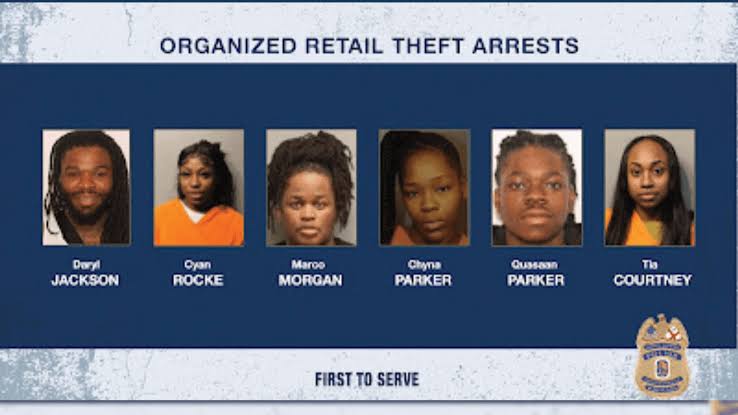
Six people are facing federal and state charges after prosecutors say they ran an organized retail theft ring that moved stolen merchandise across five states and Washington, D.C. between October 2025 and April 2026. The U.S. Attorney’s Office for the District of Maryland and the Prince George’s County State’s Attorney’s Office announced the indictments jointly, describing a network that stole goods from stores in Columbia, Rockville and Timonium, Maryland; Newark, Delaware; and King of Prussia, Pennsylvania, then resold them through Instagram and other social media, collecting payment through CashApp, bank transfers and cash.
Cases like this one keep landing because organized retail crime has become a supply chain of its own, with recruiters, boosters who steal on command, and online storefronts that move the goods before anyone notices they’re gone. The financial and safety fallout doesn’t land the same way on everyone connected to it. Here’s who actually absorbs the cost.
Small, independent retailers
Big chains can spread theft losses across thousands of locations. A single independent shop can’t. Nearly all small retail owners, 98% in a recent Forbes survey, say they’ve adopted anti-theft measures in response to rising theft, and the two most common responses are raising prices and installing security cameras. Some small business owners report losing close to a tenth of annual revenue to theft-related shrink, a hit that a chain absorbs as a rounding error and a corner store absorbs as the difference between staying open and closing.

Everyday shoppers
Retailers don’t eat theft losses quietly. The cost of unrecovered merchandise gets folded into prices at checkout, spread across every customer whether they’ve ever shoplifted or not. Industry analysts have put nationwide retail shrink losses above $100 billion a year, and that gap between what a store stocks and what it sells shows up as higher shelf prices, more locked display cases, and fewer self-checkout lanes as stores restrict access to reduce loss.
Retail workers and loss-prevention staff
Frontline employees are increasingly the ones expected to intervene, or to watch organized crews walk out with armloads of merchandise while corporate policy tells them not to physically confront anyone. The National Retail Federation’s own research found 67% of retailers reported a transnational organized retail crime group was involved in thefts against their company in the past year, and more than half of retailers surveyed said they’ve seen increases in related fraud schemes. That volume translates into more tense encounters for the people stocking shelves and working registers.
Small retailers’ insurance costs
Insurers are repricing risk for stores in areas with heavier theft activity. Retailers with greater exposure to physical crime are facing tighter underwriting standards and higher deductibles on commercial policies, and organized retail crime has been a direct driver of rising commercial insurance rates. For a small retailer, a higher deductible or a canceled policy can matter as much as the theft itself.
The people charged
For the six defendants in the Maryland case, the consequences run in the other direction. The federal charge, conspiracy to violate interstate transportation of stolen goods statutes, carries up to five years in prison per defendant, on top of separate state-level organized retail theft charges filed in Prince George’s County Circuit Court. The federal indictment covers more than $48,000 in merchandise tied to the specific interstate-transportation count, but police describe the group’s fuller reach as closer to $500,000 stolen from more than 100 stores across the five-jurisdiction operation, a broader estimate that hasn’t all translated into charged counts.
What changes because of cases like this
Law enforcement agencies have leaned into task force models to chase these networks, since a single store’s loss prevention team can’t follow stolen goods once they cross state lines onto a social media storefront. Joint federal-state prosecutions, like the one in Maryland, are becoming the standard playbook precisely because organized theft rings are built to route around any single jurisdiction’s ability to stop them.
Sources: Insurance Journal · WJLA · FOX 5 DC · National Retail Federation