

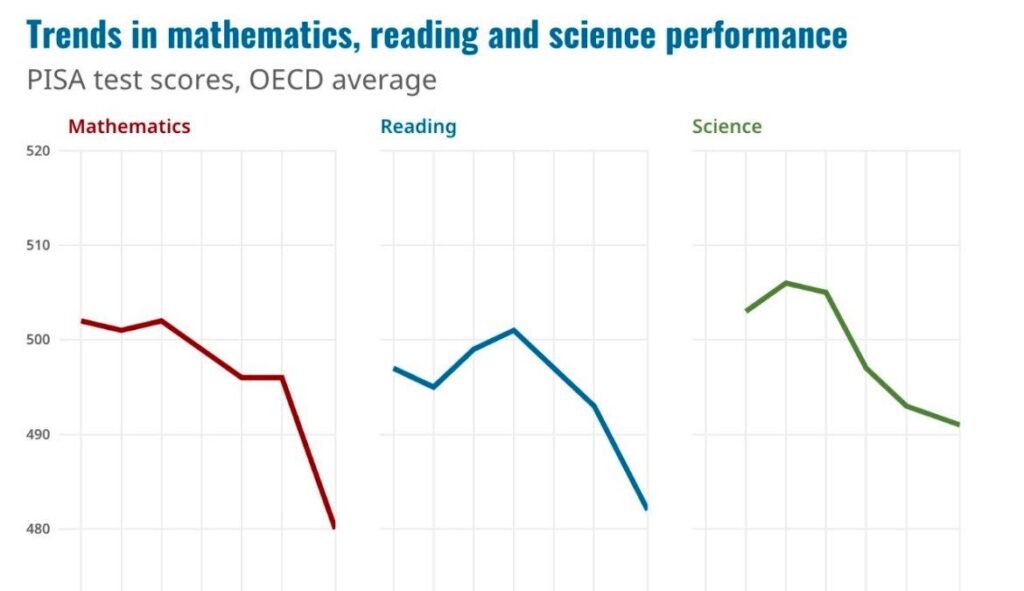
Fifteen-year-olds around the world are reading and doing math worse than their counterparts did a decade ago, according to the Organisation for Economic Co-operation and Development’s newest global assessment released Tuesday. The PISA 2025 report, based on tests given to roughly 760,000 students across 91 countries and economies, found average reading scores among OECD countries have fallen 28 points since 2015, a decline researchers equate to about a year and a half of lost learning.
What does the report blame for the decline?
OECD researchers pointed to a mix of factors: longer average screen time, a drop in reading for enjoyment, heavier reliance on short-form video and social media feeds, and what the report describes as unguided use of AI tools for schoolwork. Reading posted the sharpest recent slide, down 14 points since just 2022. Math performance has also weakened over the same decade-long window, while science scores held roughly steady between 2022 and 2025 after years of decline.
The organization said one in five 15-year-olds tested now qualifies as a low performer across all three subjects, up from about 16% in the last assessment cycle in 2022. PISA 2025 was the largest version of the study to date, both in the number of participating economies and the number of students sampled.

Are all countries affected equally?
No. The OECD’s data shows wide variation by country, with some education systems posting smaller declines or modest gains even as the overall average slipped. Researchers also flagged a persistent link between the drop-off and chronic teacher shortages in several member countries, which the report says has made it harder for schools to give struggling students extra attention.
Education officials in multiple OECD countries said Tuesday they were reviewing the findings before deciding on policy responses, which in past cycles have included revised curricula, restrictions on classroom phone use, and increased reading-instruction funding.
Related from BeezLoop: Nine Lebanese Schools Still Sheltering Displaced Families as New School Year Approaches, A Principal Allegedly Told Him to Change His Name to Beat the Background Check and Schools Banned Phones.






[…] on BeezLoop: teen reading and math scores hit record lows in the latest PISA report, and how Cuban Miami is feeling about Trump […]