

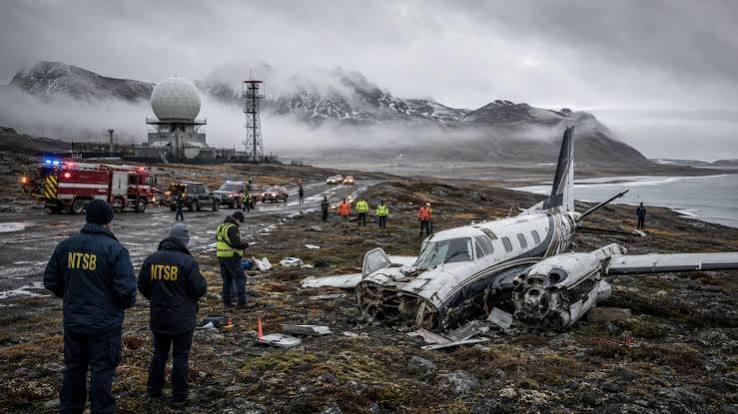
A chartered Cessna 441 Conquest II crashed while trying to land at a remote radar site on Alaska’s Bering Sea coast on Thursday, killing all eight people on board. The plane was attempting to reach Cape Newenham Long Range Radar Site Airport, about 450 miles west of Anchorage, when it went down in thick fog.
The flight had taken off from Ted Stevens Anchorage International Airport and made one missed approach at Cape Newenham due to poor visibility before the crash happened on what appears to have been a second attempt. The aircraft was operating under instrument flight rules, meaning the pilots were flying by instruments alone because the weather didn’t allow a visual approach.
Who Was on the Plane?
Eight people died: two U.S. Army Corps of Engineers employees, four contractors, and two pilots. The Army Corps had chartered the flight for work at the radar site, part of a network of remote installations that tracks aircraft across Alaska’s airspace and along its borders.

How Search and Rescue Responded
An Alaska Air National Guard HH-60W Jolly Green II helicopter reached the crash site by Thursday evening. Personnel from the 212th Rescue Squadron confirmed there were no survivors. Recovery efforts at the site have been complicated by the same remote location and weather that likely contributed to the crash in the first place.
What Investigators Are Looking At
The National Transportation Safety Board is investigating, and early attention is centered on the weather at the time: low visibility, a missed first approach, and a second attempt that ended in the crash. That sequence, a failed approach followed by another try in the same poor conditions, is a pattern investigators look at closely in weather-related crashes, though a final cause won’t be confirmed until the NTSB completes its report, a process that typically takes a year or more.
Cape Newenham’s isolation is itself part of the story. The radar sites that make up Alaska’s early-warning network sit in some of the most weather-exposed terrain in the country, reachable only by air, which means the people who maintain them accept a level of operational risk that most infrastructure workers never have to consider.
Related from BeezLoop: 5 Dead After Amazon Prime Air Cargo Plane Overruns Runway at Miami International Airport,…, Two Killed After Small Plane Crashes and Catches Fire Moments After Takeoff Near Tampa and News Helicopter Crash Covering LA Bus Collision Kills Pilot, Photojournalist Eliana Moreno,….





[…] on BeezLoop: a charter plane crash near a remote Alaska radar site killed all 8 aboard, and a news helicopter crash in Los Angeles killed its pilot and a […]