
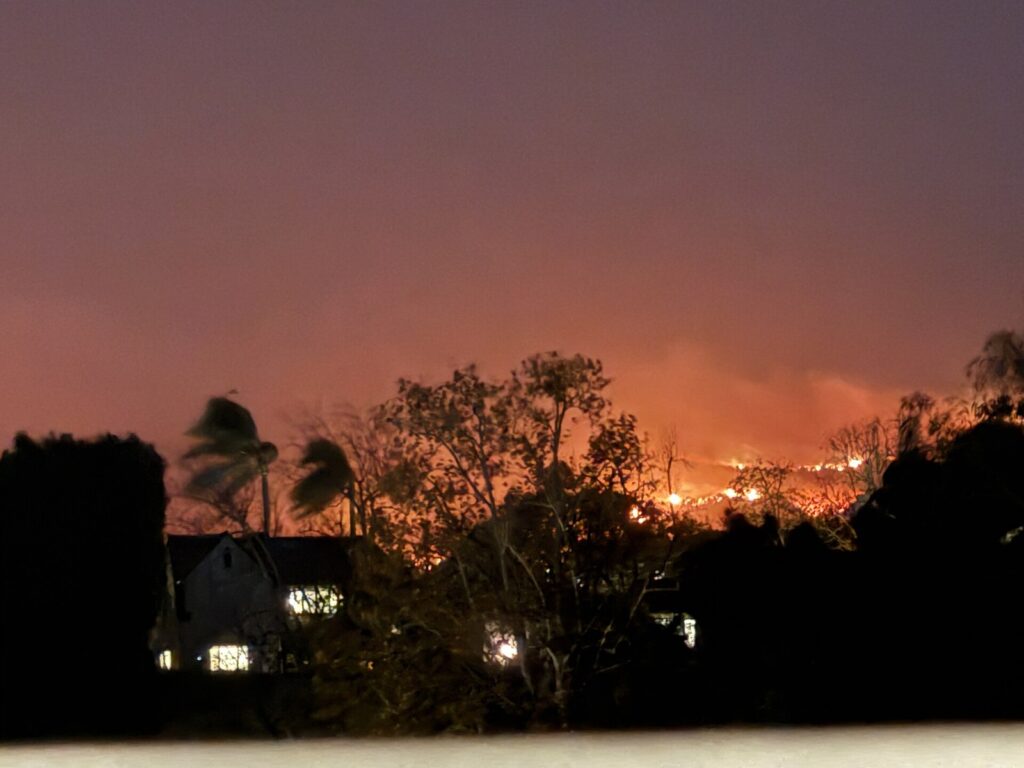
A federal jury in Los Angeles convicted Jonathan Rinderknecht on Friday of starting the fire that became the Palisades Fire, the January 2025 blaze that killed 12 people and burned about 6,800 homes. Jurors reached their verdict at about 2:45 p.m. after nearly three days of deliberation, NBC Los Angeles reported. It was his second trial. The first ended in June with a jury deadlocked 10-2 in favor of acquittal.
Rinderknecht, 30, faces up to 40 years in federal prison. Sentencing is set for March 17, 2027.
How did prosecutors say the Palisades Fire started?
They said it started a week earlier as a different fire. Prosecutors argued Rinderknecht deliberately set the Lachman Fire, a small brush fire, in the early hours of Jan. 1, 2025. Firefighters put it out, but embers kept smoldering underground for six days. On Jan. 7, gusty Santa Ana winds reignited them, and the fire exploded through Pacific Palisades.

To tie him to the first fire, prosecutors used cellphone location data, footage from fire-alert cameras, his ChatGPT search history and fire images he’d generated with ChatGPT earlier, a barbecue lighter found in his car, and statements they said were lies to investigators. “Piece it together. Look at it as a whole,” prosecutor Danbee Kim told jurors in closing.
He was convicted of two counts: destruction of property by means of fire, and arson affecting property used in interstate commerce. Prosecutors reworked the charges after the first trial.

What did the defense argue?
That the case was all circumstance. No one saw the Lachman Fire start, and no camera caught the moment of ignition. Defense attorney Steve Haney pointed to 67 lighter tests that failed to show sustained fire spread, argued New Year’s Eve fireworks could have started the fire, and said investigators never got Verizon records that might have shown who else was nearby. He argued the evidence wasn’t enough to prove the fire was set on purpose. His team is reviewing options for an appeal.
Rinderknecht showed no visible reaction. His father, Joel, called the verdict “a miscarriage of justice.”
What does the verdict mean for Palisades Fire victims?
“Twelve people lost their lives, 6,800 homes burned, $25 billion in damages,” said Bill Essayli, first assistant U.S. attorney in Los Angeles. “And now we have the answer to that.”
Local leaders were more careful. “No verdict can bring back the lives lost or erase the pain families have endured,” Mayor Karen Bass said. City Councilmember Traci Park said, “It’s not full accountability. There is still a lot more for us to do.” Many residents have pointed to other failures that let a small fire become a catastrophe, including whether the Lachman Fire was fully put out and how the city prepared for the Santa Ana winds.
The BeezLoop Take
A man who sets a fire is responsible for what it does, and a jury has now decided this man set it. But one conviction doesn’t explain how a fire that firefighters had already responded to sat underground for six days in a city under a wind warning.
The criminal case is closed except for sentencing and appeals. Will the questions about mop-up, warnings and water get the same public airing, or will one arsonist become the whole story?
Sources: NBC Los Angeles · U.S. Attorney’s Office, Central District of California · KTLA (video)