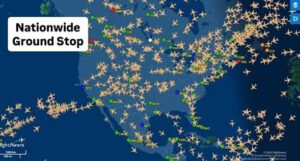

Short answer: the network that carries voice and radar data between America’s air traffic control centers runs partly on equipment from the early 2000s, and on Friday some of it failed. Rather than let controllers work with garbled data, the FAA stopped every departure in the country for about five hours. More than 10,000 flights were delayed and over 4,000 canceled.
“We have old, old switches, old routers. We use 1980s little copper lines,” Transportation Secretary Sean Duffy said Friday night, Fox Business reported. Now he wants Congress to hand over $50 billion to replace it.

How does air traffic control actually work?
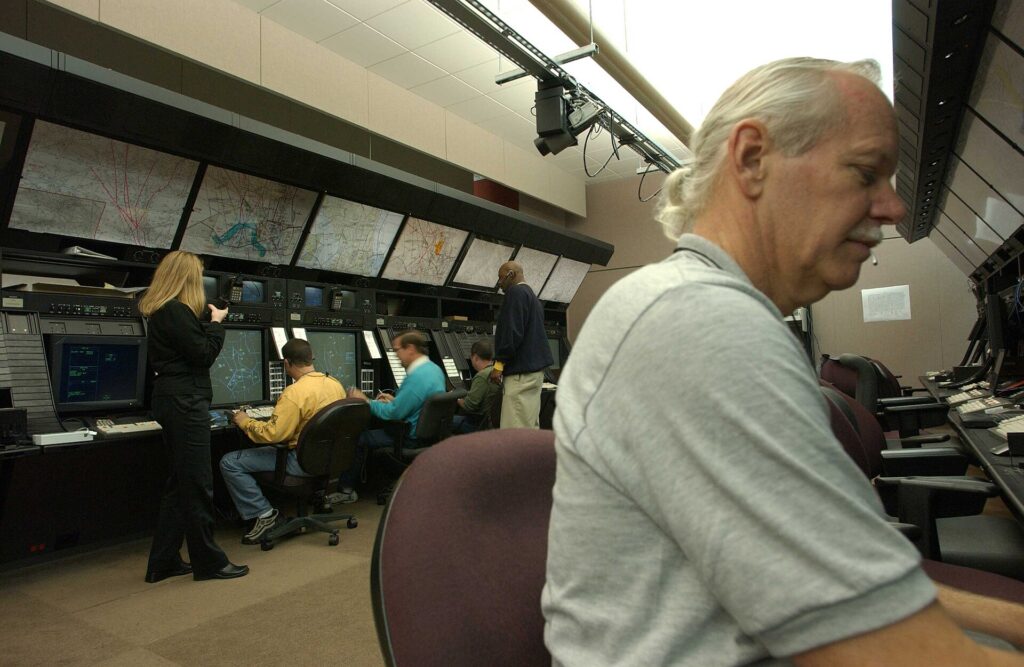
There are three layers. Airport towers handle takeoffs and landings. Approach controllers handle the climb and descent near big airports. In between, 22 air route traffic control centers handle planes at cruising altitude, guiding them across long distances, Roll Call explained. Those centers are what failed Friday.

The centers depend on a private communications backbone called FAA Telecommunications Infrastructure, which links them to radars, radios and each other. L3Harris runs it under a contract first awarded in July 2002. An FAA-commissioned safety review in November 2023 called that network “obsolete” and warned a failure could cut off a facility or a whole region, CBS News reported.
What broke on Friday?
“Our routers actually got overloaded with data,” Duffy said, and they started sending controllers inconsistent data, “and because of that, we shut the system down.” Senior government sources told CBS the early suspect is a batch of Cisco 600-series routers made between 2001 and 2006, and that an update to the network caused a reboot and crash. Those sources also gave conflicting accounts, so treat the details as preliminary.
Homeland Security Secretary Markwayne Mullin called it “just a telecommunication outage” and said there was “no connection” to the Microsoft outage the same week and no sign of a cyberattack. Our live coverage of the day is here.
What would $50 billion fix?
Here’s the money trail. Congress already approved $12.5 billion for air traffic control in the July 2025 budget law, including $1.9 billion to upgrade the 22 en route centers. On Thursday, Duffy and budget director Russ Vought formally asked for $30.1 billion more. Friday night, after the outage, Duffy and Mullin raised the ask to $50 billion without spelling out what the extra $20 billion would buy.
Some of the fix is already underway. The FAA hired Rohde & Schwarz in a roughly $5 billion deal to replace up to 462 old voice switches, and more than 40 are installed. Duffy said the new equipment “had not experienced the same failures.” The bigger, unfunded pieces are a new telecom network and new radars and centers. Senate Commerce Republicans noted the last new en route center was built when Lyndon Johnson was president.
Will this happen again before Thanksgiving?
Duffy says it could. “You will have more of these,” he warned, unless Congress pays to rebuild. Sen. Maria Cantwell, who takes over the Senate Commerce Committee in January, said her committee will review what failed. If you’re flying for Thanksgiving, book early flights, keep your airline’s app on, and know that if your flight is canceled and you don’t take a rebooking, you’re owed a refund.
The BeezLoop Take
Duffy is right that the system is old, and it’s not a partisan problem. Controllers have been working around this equipment for years. Friday was the bill coming due.
But going from $30 billion to $50 billion overnight, with no breakdown, isn’t a plan. Congress should fund the fix and demand a parts list, a schedule and a single person accountable for delivering it, since the money already approved hasn’t stopped Friday from happening.
The open question: does Congress move before the holiday rush, or does this turn into another budget fight while 22 centers keep running on decades-old routers?
Sources: CBS News · Roll Call · Fox Business · NewsNation (video)