
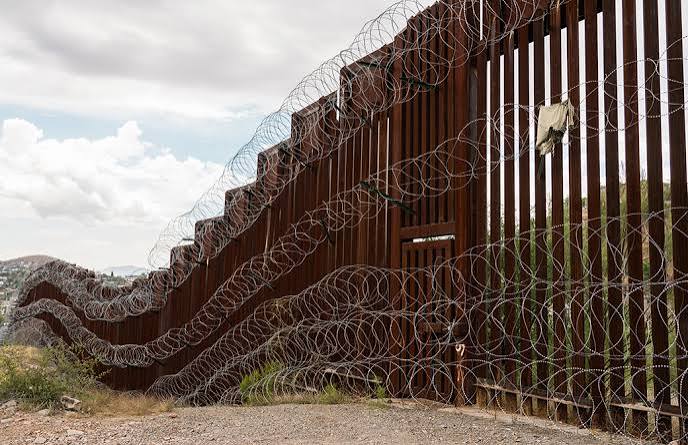
Border wall construction in West Texas’s Big Bend region can start again. The Supreme Court on Monday lifted a lower court’s order that had stopped the work for more than a month, siding with the Trump administration while the lawsuit against the project goes on. Justice Ketanji Brown Jackson was the only justice to note that she would have turned the administration down.
The project covers the Border Patrol’s Big Bend sector, which runs more than 500 miles along the Rio Grande and includes Big Bend National Park. The plans include new 30-foot steel bollard walls, more than 200 miles of patrol roads and about 17 miles of vehicle barriers, CBS News reported, citing Customs and Border Protection.

Why did the Supreme Court let the border wall go forward?
In a short unsigned order, the majority said the lower court likely didn’t have the power to hear the main claim: that the Homeland Security secretary went too far when he waived environmental laws to speed up construction. The justices said stopping the work “impedes the Government from advancing its ‘compelling interests’ in border security,” and that the government’s interest “outweighs any aesthetic, recreational, and environmental harm alleged.”

U.S. District Judge Kathleen Cardone in El Paso had blocked “any construction or ground disturbing activities” in the sector last month. Solicitor General D. John Sauer argued that her order disrupted “the government’s ability to secure a quarter of the southern border against cartel incursions.” The Supreme Court’s order holds until the justices decide whether to take the full case, or until the El Paso court rules.
Who is fighting the Big Bend wall?
The challengers are the Center for Biological Diversity, a professional river guide and a nonprofit that preserves a historic church in Ruidosa, Texas. They say the project would permanently change Big Bend National Park, Big Bend Ranch State Park and “nearly 200 miles of the Rio Grande Wild and Scenic River corridor.” Laiken Jordahl of the Center for Biological Diversity said the administration is “hellbent on destroying one of America’s greatest national parks, and the Supreme Court just gave them the green light.”
CBP Commissioner Rodney Scott has said the 30-foot wall itself won’t cut through the national park, though other infrastructure would, according to CBS. The two sides don’t even agree on the need. The government says more than 89,000 people were caught crossing in the sector from 2021 to 2025. The plaintiffs say Big Bend ranks last in crossings among the seven southwest border sectors. Texas politics are shifting fast too: the state flipped in last week’s midterms, and Houston just stopped calling ICE after traffic stops.
The BeezLoop Take
The administration’s own numbers make this a hard sell. Big Bend is remote, rugged and, by the plaintiffs’ count, the least-crossed sector on the southern border. Putting 30-foot walls and hundreds of miles of roads there spends a lot of money where the problem is smallest.
The legal reasoning matters more than the wall. If courts can’t review a secretary’s decision to waive environmental laws, there’s not much check left on where the government builds. That reaches well beyond one park.
The open question: how much gets built before a court rules on whether the waivers were legal at all, and can any of it be undone if they weren’t?
Sources: Supreme Court order, No. 26A560 · CBS News · MS NOW · 9NEWS (video)